The injury
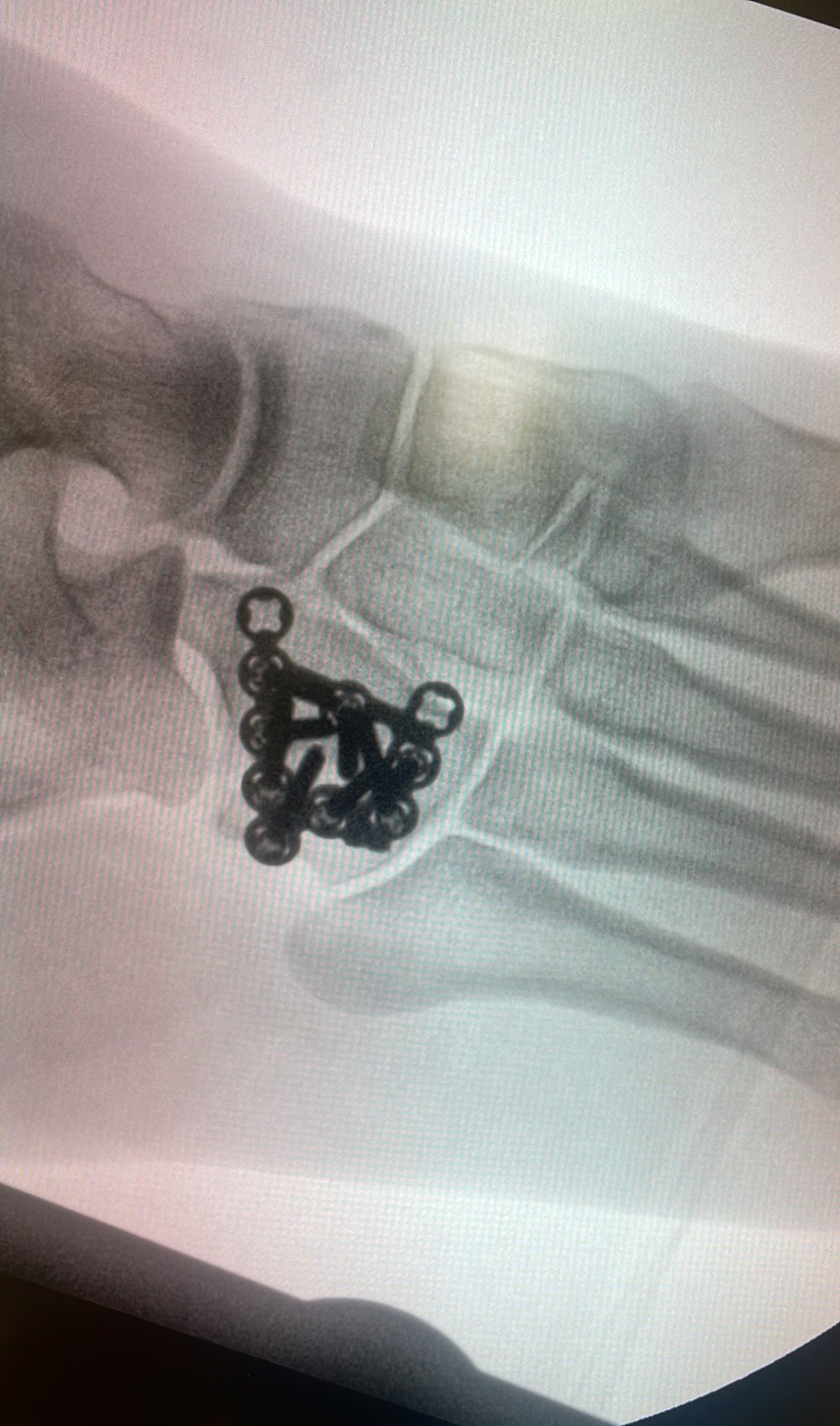
The cuboid supports the lateral column of the foot. It is usually compressed — the so-called nutcracker injury — when the forefoot is forced into abduction, and frequently occurs in association with a Lisfranc or navicular injury.
Treatment
Undisplaced fractures are treated in a boot. Where the lateral column is shortened, length is restored and maintained with a small plate, occasionally supplemented by a temporary bridging plate or external fixator, so that the shape of the foot is preserved.
Recovery after surgery
The timeline below is a typical pathway after fracture surgery. The exact plan depends on the injury and the fixation, and will be confirmed at each review.
| Stage | What to expect |
|---|---|
| Weeks 0–2 | A temporary cast is applied and the leg must be kept non-weight-bearing. During this period the limb should be elevated, with the toes above the level of the nose, ideally for 55 minutes out of every hour, to help control swelling. You can mobilise with crutches, a knee scooter or an iWALK hands-free crutch (see recovery equipment). |
| At 2 weeks | If possible, the cast is changed to a boot so that soft-tissue management can begin: desensitisation, and moisturising of the scars. Creams such as Kelo-cote or castor oil can be used for wound care (see recovery equipment). If a boot is not yet appropriate, a further cast is applied from week 2 to week 6. |
| At 6 weeks | The cast is removed and you move into a boot, typically a short surgical boot where possible, or a Vacoped boot, depending on the type of surgery. |
| Physiotherapy | Physiotherapy starts as soon as the limb is accessible, which is either at 2 weeks or at 6 weeks. |
| Exercise | Core and upper-body work can start as soon as the cast has been removed and you are in a boot, which can be as early as week 2, but with nothing through the injured limb. From 6 weeks, gentle range-of-motion exercise can begin, such as a cross-trainer, a fixed (static) bike and swimming. Impact sports such as running and jumping can normally start at 12 weeks; this depends to some extent on the fracture configuration. |
| Longer term | These are often complex and severe injuries. Improvement can take up to 18 months to reach a new baseline. Swelling often persists for months, typically around 9 to 12 months, and some swelling often persists lifelong, without complete resolution of the ankle swelling. |
Risks of surgery
The risks associated with this surgery include, but are not limited to:
- Pain
- Bleeding
- Infection
- Scarring
- Damage to nerves and blood vessels
- Deep vein thrombosis (DVT) — a blood clot in the veins of the leg
- Pulmonary embolism (PE) — a blood clot that travels to the lungs, which can be life-threatening
- Stiffness
- Non-union — failure of the bone to heal
- Malunion — the bone healing in an incorrect position
- The need for further surgery, such as removal of metalwork
These risks are discussed individually before surgery.
Equipment Mr Hester recommends
As an Amazon Associate, anklefracturesurgeon.co.uk earns from qualifying purchases.
Arranging an appointment. Private patients are seen at King Edward VII's Hospital, The London Clinic, Cromwell Hospital and HCA Healthcare at The Shard.
Call 020 7046 8004 or send an enquiry.
Radiographs are from my own practice, reproduced uncropped with identifying details removed. This page provides general information and is not a substitute for individual assessment.